What is oracy?
Oracy is the ability to express yourself fluently in speech. In our day-to-day lives, we speak to different people in different ways and we want to equip pupils at St Matthias pupils to be able to do this confidently. This could be through responding to our friends in the playground; using scientific language in an experiment or responding to someone’s opinion about a book. By improving the way in which we speak, this then impacts how we write.
Voice 21
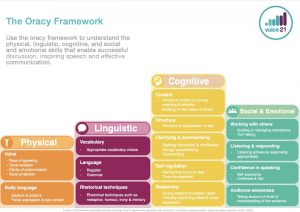
Voice 21 is an oracy education charity, which supports the teaching of oracy in school. It puts oracy at the heart of teaching and learning in order to increase engagement in learning, improve academic outcomes and foster wellbeing and confidence. At St Matthias, we have evaluated our strengths and next steps for oracy, using Voice21’s audit toolkit.
Oracy in our curriculum
In addition to our rich, daily interactions with our pupils, our goal at St Matthias is for oracy to be embedded across the curriculum from EYFS to Year 6.
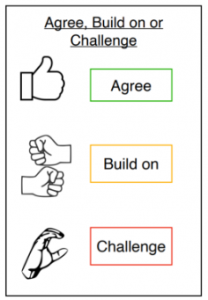
Classroom talk is a large part of our practice at St Matthias, where teachers can model language structures and interactions, as well as targeting questions to ensure all pupils contribute to the learning. Opportunities for partner and group talk are also embedded to encourage listening skills and turn-taking. Pupils are provided with subject-specific sentence stems, suitable for their age groups, further supporting pupil engagement and confidence. Please see here for sentence stems that can be used to support oracy development, as well as here for roles that support with group discussions.
We try to build in lots of opportunities for all pupils to present or speak in front of their peers such as through class assemblies; after-school clubs; reading work aloud; offering opinions or presenting learning. These allow pupils to practise their speaking skills in a safe and celebratory environment.
Examples of activities to support with the development of oracy in lessons include, but are not limited to the following:
- Conscience alley
- Giving and following instructions
- Debates
- Freeze frames with thought tracking
- Book talk
- Performance poetry
- Oral storytelling
- Hot seating
- Role playing
- Interviews
For pupils who may struggle with communication and speech, we try to use consistent physical movements, such as Makaton, to also support with the development or understanding.
Oracy Progression
The oracy skills expected of each year group are outlined in our progression map, which is shared with staff, in order to support with planning.
Please see here for our progression map.
Supporting at Home
We encourage all parents and carers to try some of the following activities to support oracy at home:
- Read aloud – reading aloud, even if at a much higher level to your child, helps children’s talking, listening and storytelling skills. They can build their vocabulary, learn to express their ideas and understand more complex language structures.
- Vlog – recording allows children to practise their speaking and presenting skills – they can send video messages to family and friends or simply keep a video diary for themselves!
- Play word games – 20 Questions, Guess Who? and I Spy are great games to support children’s use of language.
- Talk – talking to children about their day is the best way to support oracy.
- Speak on the phone – encourage your child to speak to their family or friends on the phone, rather than messaging.