Oracy is the ability to express yourself fluently in speech. At St Matthias, our oracy curriculum enables pupils to articulate their ideas clearly, develop understanding and engage confidently with others. We know that spoken language underpins all learning, supporting pupils to succeed in reading, writing and across the wider curriculum.
Learning is carefully structured so that pupils build their vocabulary, fluency and confidence in spoken language over time. Through purposeful talk and discussion, pupils learn to express their ideas clearly, listen actively and respond thoughtfully in a range of contexts.
In the Early Years, pupils develop the foundations of oracy through storytelling, play and high-quality interactions, building their speaking and listening skills. These foundations are developed further as pupils move through the school, with increasing opportunities for structured talk and presentation.
From Years 1 to 6, pupils take part in a wide range of meaningful speaking and listening opportunities, including discussion, debate, drama and performance. These experiences support pupils in organising their ideas, adapting their language and communicating with clarity and confidence. For pupils who may struggle with communication and speech, we try to use consistent physical movements, such as Makaton, to also support with the development or understanding.
Teaching is supported by our work with Voice 21, ensuring that oracy is embedded across the curriculum. Teachers use modelling, targeted questioning and structured talk strategies, including sentence stems and defined roles, to support all pupils in participating fully.
Oracy is prioritised across all subjects, enabling pupils to rehearse ideas, deepen understanding and use subject-specific vocabulary. Regular opportunities for presentation and performance allow pupils to develop confidence and take pride in their communication skills.
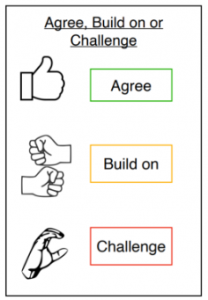
Sentence stems that can be used to support oracy development
Roles that support with group discussions
Knowledge and skills are revisited and applied across the curriculum, enabling pupils to become increasingly fluent and independent speakers. Through this approach, pupils develop clarity, confidence and a strong command of language, supporting their learning, relationships and future success.
As a result, pupils leave St Matthias as articulate and confident communicators who can express their ideas clearly, listen with understanding and engage thoughtfully in a wide range of contexts.
Supporting at Home
We encourage all parents and carers to try some of the following activities to support oracy at home:
- Read aloud – reading aloud, even if at a much higher level to your child, helps children’s talking, listening and storytelling skills. They can build their vocabulary, learn to express their ideas and understand more complex language structures.
- Vlog – recording allows children to practise their speaking and presenting skills – they can send video messages to family and friends or simply keep a video diary for themselves!
- Play word games – 20 Questions, Guess Who? and I Spy are great games to support children’s use of language.
- Talk – talking to children about their day is the best way to support oracy.
- Speak on the phone – encourage your child to speak to their family or friends on the phone, rather than messaging.