[vc_row css_animation=”” row_type=”row” use_row_as_full_screen_section=”no” type=”full_width” angled_section=”no” text_align=”left” background_image_as_pattern=”without_pattern” css=”.vc_custom_1601929528683{padding-bottom: 50px !important;}” z_index=””][vc_column][vc_column_text]
At St Matthias, we are committed to developing confident, fluent readers who are able to critically analyse texts and garner information from a range of sources and have a thirst for reading a wide variety of texts. All pupils will be able to read with accuracy, speed, confidence, fluency and understanding and will flourish as readers via a rigorous and systematic programme led by well trained, expert teachers in language rich environments. Our curriculum allows pupils to see themselves in the stories curated and plans for regular opportunities to expand their vocabulary. We aim to ensure the pupils identify themselves as readers by nurturing their love for reading so as to develop a life-long enjoyment of reading and books.
Reading Curriculum
We are so proud of the love of reading that has been instilled in the children at St Matthias and we want to continue to develop this, whilst ensuring they feel confident when decoding and reading. We are therefore exceptionally proud of our reading curriculum, as we know that it is a strong foundation to build key reading skills.
To see our reading curriculum, please click here.[/vc_column_text][/vc_column][/vc_row][vc_row css_animation=”” row_type=”row” use_row_as_full_screen_section=”no” type=”full_width” angled_section=”no” text_align=”left” background_image_as_pattern=”without_pattern”][vc_column][vc_column_text]
Reading at St Matthias
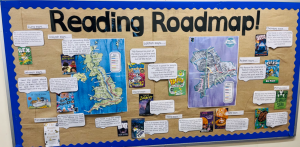
Reading is integral to all learning at St. Matthias. We utilise any opportunities we can to foster Love of Reading in every one of our pupils. Reading has a high profile within the school, with daily reading sessions in KS2 taught every day, as well as daily Phonics in EYFS and KS1. As well as this, our Accelerated Reader programme is a powerful tool for monitoring and managing independent reading practice while promoting reading for pleasure.
Children have been taught the skills needed to initially recognise sounds and hear sounds in words; blend sounds to create words, read sentences, paragraphs and then move on to whole texts with accuracy and understanding. Reading occurs in every subject of the curriculum and children transfer these skills across all lessons.
In addition to this, we have established daily story times for children to listen to the teacher, have opportunities to read with another class and change library books. We have invested in books to appeal to our more reluctant readers, as well as those more representative of the children we teach.
We use all opportunities to also engage families, carers and other relatives as readers, with events in the past such as:
- Our World Book Day Breakfasts (where children, parents and carers were invited to share stories over breakfast dressed as their favourite book characters).
- Reading Taster Breakfasts; these allow children, parents and carers to see the new books that would be available in the library next term.
- Whole school projects inspired by significant texts
- Our whole-school Black History Month activities and projects in lessons, as well as the yearly Black History Month Event, bring together cross-curricular class work and a variety of entertainment and celebration.
- We also have a parents reading table for the exchange and sharing of books.
 [/vc_column_text][/vc_column][/vc_row][vc_row css_animation=”” row_type=”row” use_row_as_full_screen_section=”no” type=”full_width” angled_section=”no” text_align=”left” background_image_as_pattern=”without_pattern” css=”.vc_custom_1614876773397{padding-bottom: 20px !important;}” z_index=””][vc_column width=”1/5″][vc_single_image image=”4606″ alignment=”center” qode_css_animation=””][/vc_column][vc_column width=”1/5″][vc_single_image image=”4607″ alignment=”center” qode_css_animation=””][/vc_column][vc_column width=”1/5″][vc_single_image image=”4604″ alignment=”center” qode_css_animation=””][/vc_column][vc_column width=”1/5″][vc_single_image image=”4608″ alignment=”center” qode_css_animation=””][/vc_column][vc_column width=”1/5″][vc_single_image image=”4614″ alignment=”center” qode_css_animation=””][/vc_column][/vc_row][vc_row css_animation=”” row_type=”row” use_row_as_full_screen_section=”no” type=”full_width” angled_section=”no” text_align=”left” background_image_as_pattern=”without_pattern”][vc_column width=”1/5″][vc_single_image image=”4609″ alignment=”center” qode_css_animation=””][/vc_column][vc_column width=”1/5″][vc_single_image image=”4610″ alignment=”center” qode_css_animation=””][/vc_column][vc_column width=”1/5″][vc_single_image image=”4611″ alignment=”center” qode_css_animation=””][/vc_column][vc_column width=”1/5″][vc_single_image image=”4615″ alignment=”center” qode_css_animation=””][/vc_column][vc_column width=”1/5″][vc_single_image image=”4602″ alignment=”center” qode_css_animation=””][/vc_column][/vc_row][vc_row css_animation=”” row_type=”row” use_row_as_full_screen_section=”no” type=”full_width” angled_section=”no” text_align=”left” background_image_as_pattern=”without_pattern”][vc_column][vc_column_text]
Early Reading at St Matthias

At St Matthias, we strive to ensure that children have the best opportunities in an inclusive and purposeful learning environment. We place a great value on the teaching of early reading and have been highly successful at teaching children to read through our daily phonics programme, RWInc.
Phonemes – the sounds a letter/group of letters make
Graphemes – the letter/letters used to make a sound
In the Early years, children begin by building an awareness of different sound. This can include the children understanding sounds in their environment and how their body makes sounds. Songs and rhymes are also an important way for children to build an awareness of sounds in Nursery. Children are only expected to know a couple of sounds by the end of Nursery, but will quickly be introduced to new sounds in Reception.
When they are confident identifying a group of letters, children will then start to learn to blend sounds together to form words. Some children will then be able to decode sentences and begin to read simple books. They will also be looking at high frequency words, which will help them in their reading journey.
By Year 1, children will develop their confidence in reading and will be introduced to increasingly complex sounds, preparing them for more interesting and varied story books. As well as blending sounds to make words, children will be learning to break down (segment) words to be able to spell them and use their sounds in their writing.
Each June, all children in Year 1 do their phonics screening test. This is a short assessment to find out how accurately the children are reading decodable words. Children will be asked to ‘sounds out’ a word and then blend the sounds together. For example:
d–o–g dog f-air fair l-igh-t light
The children will be asked to read real words and made up ‘alien’ words.
Download Phonics Screen Check Sound Book
In Year 2, children will be using all of their previously taught sounds and using alternative spellings when learning spelling rules. It is expected that children will have completed our phonics programme by the end of Year 2.
How you can help your child at home
Encourage your child to ‘sound out’ when reading and writing. Practice the sounds using either the sound cards (which are available at Reception) or the sound mat overleaf. Encourage children to find the more tricky sounds when reading.
Diagraph: 2 letters making one sound cow start saw
Trigraph:3 letters making one sound night fair pure
Split Diagraphs: 2 vowels making one sound with a letter in between make cube bone

[/vc_column_text][/vc_column][/vc_row][vc_row css_animation=”” row_type=”row” use_row_as_full_screen_section=”no” type=”full_width” angled_section=”no” text_align=”left” background_image_as_pattern=”without_pattern” css=”.vc_custom_1601929376947{padding-bottom: 50px !important;}” z_index=””][vc_column][vc_column_text]
Below, you can find lots of resources to help you with phonics:
[/vc_column_text][/vc_column][/vc_row][vc_row css_animation=”” row_type=”row” use_row_as_full_screen_section=”no” type=”grid” angled_section=”no” text_align=”left” background_image_as_pattern=”without_pattern” css=”.vc_custom_1601929390966{padding-bottom: 50px !important;}” z_index=””][vc_column width=”1/3″][vc_single_image image=”3770″ qode_css_animation=””][vc_column_text]RWI Youtube Page
On these, you will find:
- Regular storytelling films
- Access to parents’ page
- Updates on Facebook/Twitter for regular tips
- Updates via Ruth’s newsletter
[/vc_column_text][/vc_column][vc_column width=”1/3″][vc_single_image image=”3771″ qode_css_animation=””][vc_column_text]As well as phonics training, has put an extensive range of their resources online, including:
- 72 free eBooks matched to Read Write Inc. Phonics Storybooks
- 28 Ditty practice sheets
- Parent information booklets
- 8 Speedy Green Words slideshows
[/vc_column_text][/vc_column][vc_column width=”1/3″][vc_single_image image=”3773″ qode_css_animation=””][vc_column_text]We, at St Matthias, have also provided you with the following resources to support with phonics:
Sound Practice Sheets Letter home[/vc_column_text][/vc_column][/vc_row][vc_row css_animation=”” row_type=”row” use_row_as_full_screen_section=”no” type=”grid” angled_section=”no” text_align=”left” background_image_as_pattern=”without_pattern” css=”.vc_custom_1601929390966{padding-bottom: 50px !important;}” z_index=””][vc_column][vc_column_text]
Further Reading at St Matthias
Our reading lessons follow a structured approach to reading, where vocabulary building and book analysis play a key role in our children becoming highly skilled readers.
Our reading curriculum centres around these key components:
-
Decoding
-
Fluency
-
Comprehension
-
Word Knowledge
-
Verbal Reasoning
Fluency
Each day, children in Y2-6 will read a short, pre-selected section of the text alongside their partner for 1 minute to practise building their fluency. For Y2/3, this will be the same section of text for the week and children will be expected to show improvement day on day. For Y4/5/6, the section will be based on continuity of the class text. When children are secure in their fluency (reading 120-160 words per minute), lesson time can be reallocated to a more rigorous editing and improving format.
Summarising
Summarising is a key skill and children need this to be explicitly modelled regularly. There is a daily opportunity for children to summarise as a whole class in Y2, with partners in Y3/4 and independently in Y5/6.
Story Time
Story time is a non-negotiable part of the school day. The children will listen to their teacher read the class reader for a minimum of 15-20 minutes daily, which will accumulate to a total of 75 minutes over the week. EYFS and KS1 will be using Talk Through Stories to support planning and vocabulary sessions (overview here) while KS2 will read books from the reading spine, with an additional focus on representative books.
Jump Into A Book Workshops – Jump Into a Book intervention Letter
Extract
Our Friday reading lessons are extract lessons that allow children to build a wider understanding of the world. Children are exposed to a wide range of poems, plays, non-fiction and fiction texts and are able to answer questions about them in different formats. Extract resources can be found on the cracking comprehension webpage.
[/vc_column_text][/vc_column][/vc_row][vc_row css_animation=”” row_type=”row” use_row_as_full_screen_section=”no” type=”grid” angled_section=”no” text_align=”left” background_image_as_pattern=”without_pattern” css=”.vc_custom_1601929390966{padding-bottom: 50px !important;}” z_index=””][vc_column][vc_single_image image=”4612″ alignment=”center” qode_css_animation=””][/vc_column][/vc_row][vc_row css_animation=”” row_type=”row” use_row_as_full_screen_section=”no” type=”full_width” angled_section=”no” text_align=”left” background_image_as_pattern=”without_pattern”][vc_column][vc_column_text]
We Are Storytellers!
During lockdown, some of our children recorded themselves reading stories.
[/vc_column_text][/vc_column][/vc_row][vc_row css_animation=”” row_type=”row” use_row_as_full_screen_section=”no” type=”full_width” angled_section=”no” text_align=”left” background_image_as_pattern=”without_pattern” css=”.vc_custom_1601929528683{padding-bottom: 50px !important;}” z_index=””][vc_column width=”1/3″][vc_video link=”https://www.youtube.com/watch?v=ppLMdLT4Eoc&list=PLI4tKYg3-PI6zRgwHzrMs30zHf2mZDttL”][/vc_column][vc_column width=”1/3″][vc_video link=”https://www.youtube.com/watch?v=P2jeky3IiZo”][/vc_column][vc_column width=”1/3″][vc_video link=”https://youtu.be/OrZtR5AEP4k”][/vc_column][/vc_row][vc_row css_animation=”” row_type=”row” use_row_as_full_screen_section=”no” type=”full_width” angled_section=”no” text_align=”left” background_image_as_pattern=”without_pattern” css=”.vc_custom_1601929528683{padding-bottom: 50px !important;}” z_index=””][vc_column width=”1/3″][vc_video link=”https://youtu.be/N1-AZiYceG8″][/vc_column][vc_column width=”1/3″][vc_video link=”https://youtu.be/oMTW13BM_1s”][/vc_column][vc_column width=”1/3″][vc_video link=”https://youtu.be/5nPEHHdjoQE”][/vc_column][/vc_row][vc_column][/vc_column][vc_column_text]
I am text block. Click edit button to change this text. Lorem ipsum dolor sit amet, consectetur adipiscing elit. Ut elit tellus, luctus nec ullamcorper mattis, pulvinar dapibus leo.
[/vc_column_text]